Culvert washout vs. bridge scour: how to tell them apart in imagery
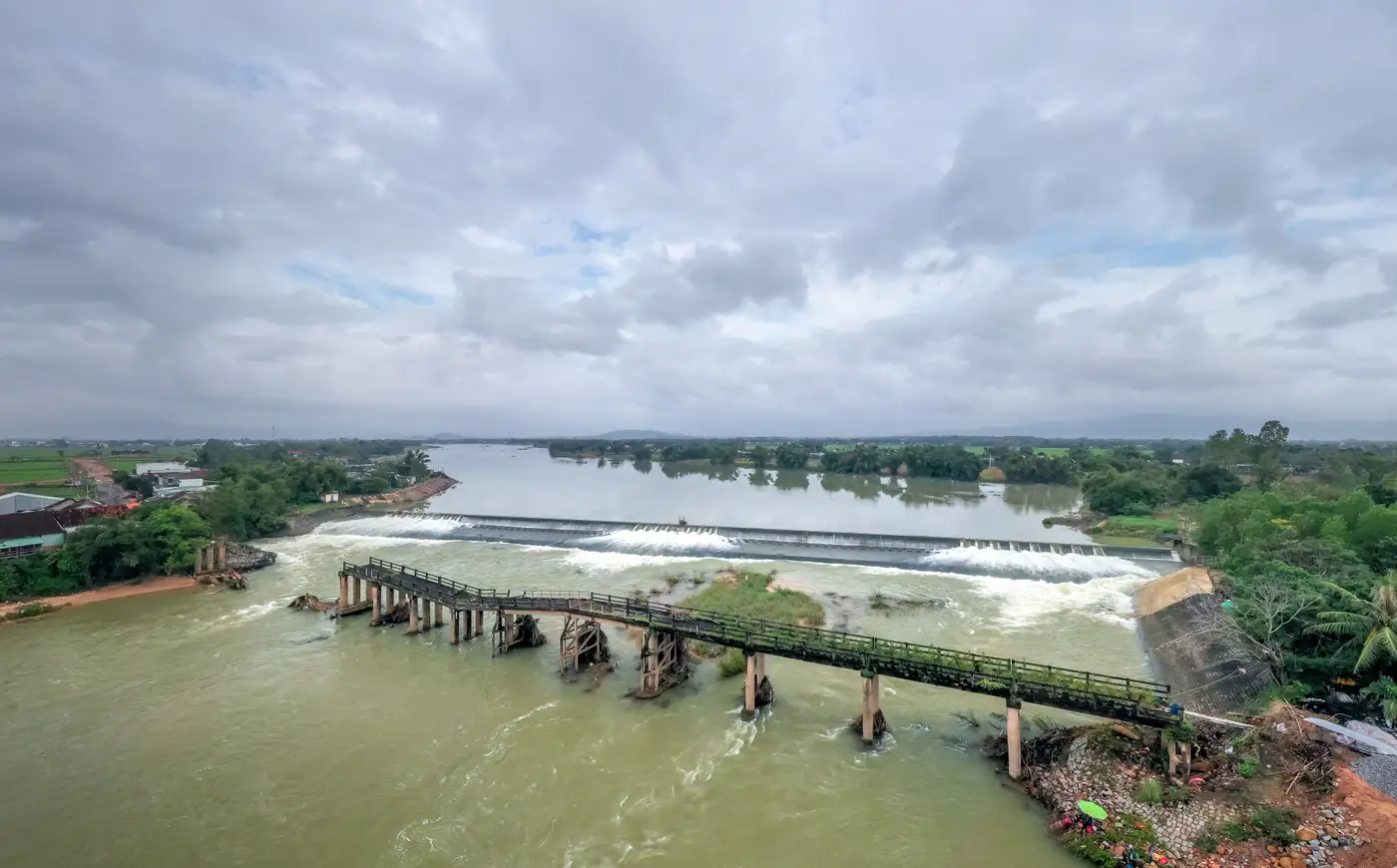
Both failures close a road. Both show up on a ground report as "bridge out" or "road out" with no further detail. But a culvert washout and a scoured bridge pier fail differently, and they read differently in an imagery pass. If your job is routing relief convoys around whatever broke, that difference tells you whether the fix is a day's work with a grader or a structural problem nobody touches until an engineer signs off.
What a culvert washout actually shows
A culvert washout is a fill failure. Water comes up over or around a pipe that was sized for a smaller storm, the fill material around it saturates, and the roadbed drops into the gap. In a before/after image pair you're looking for a clean break in the road surface at a point crossing, often with a visible scour channel on the downstream side where the fill eroded out. The road embankment itself goes missing over a short span, usually under 10-15 meters. Debris and sediment fan out downstream in a cone shape, lighter in tone than the surrounding ground if it's fresh deposit.
The giveaway is that the road is gone but the channel crossing underneath it was small to begin with, often invisible in the "before" pass because the culvert itself doesn't show at 0.5 m GSD. You're inferring a culvert was there from the road's prior continuity and the channel's prior narrowness. After the event, you get a gap in the road with washed material on one or both sides and no deck remnant visible.
What bridge scour looks like before it's obvious
Bridge scour is different because the bridge deck often survives, at least for a while. What fails is the ground around the piers or abutments, undermined by fast water working against foundations that were never designed for that velocity or that duration of flow. In imagery this shows as a visible deck still spanning the crossing, but with the approach fill pulled away from one or both abutments, exposed pier footings, or a pier that's visibly tilted or shifted from its prior position. Sometimes the deck itself has dropped or rotated even though it hasn't fully collapsed.
The before/after comparison here tracks a change in geometry around a structure that's still standing: a shifted pier, a pulled-away abutment, a deck sitting a few degrees off level. If you only glance at the latest pass, a scoured bridge can look passable. The deck's there, the road leads up to it, nothing screams "closed" the way a washout does. That's exactly why scour is the more dangerous one to miss when you're moving loaded trucks. A convoy routed across a scoured deck on the assumption that "the bridge is still there" is a different kind of incident than one that gets turned back at an obvious washout.
Why the distinction changes your routing call
A culvert washout usually means: find the detour, or wait for a grader and some fill to get a temporary crossing back. It's a maintenance-crew problem, measured in days. Bridge scour means: don't send anything over that structure until someone with a load rating can look at it, because the failure mode is progressive and a deck that held yesterday can give today. Lumping both under "bridge out" on a ground report erases that distinction, and it's the distinction that decides whether you reroute around a segment for a week or flag a structure for inspection before any convoy touches it again.
This is the gap a change-detection pass over the network is built to close. Instead of waiting on a driver's radio call describing "some kind of washout" at a crossing nobody's confirmed by eye, a disruption layer built from the latest imagery against the last usable pass marks the specific segment and shows you the before/after pair behind the flag, so your dispatch team can see a clean culvert gap versus an undermined pier before a single truck gets sent toward either one. That's the sort of call you shouldn't be making off a secondhand description, and it's the reason a route disruption layer tied to the latest imagery pass exists in the first place.
If your network's got crossings you can't get eyes on fast enough, it's worth seeing what that layer flags on your next event-driven pass.